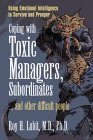
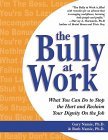
"In the old days, if your boss made a habit of yelling at you in front of your co-workers, "all we could say was tough luck, you've got a crappy boss," says Toronto employment lawyer Janice Rubin. "So maybe look for another job." Then, a decade ago, the corporate bullies met their match: Canadian judges. They started to rule that if a boss was so mean to an employee that he got sick or quit, the boss, or his company, should have to compensate the target for the abuse."
Email Link
|
iFaveIt
|
Comments
|
Read: david-kilgour.com
"Ask bosses what makes employees happy at work, and many are likely to think in terms of tangible rewards: a good salary, a pleasant office, generous benefits.
Those play a role in job satisfaction, of course. But increasingly, workplace specialists are discovering that for many workers, the "happiness factor" depends heavily on intangibles, such as respect, trust, and fairness."
Email Link
|
iFaveIt
|
Comments
|
Read: communityinvestmentnetwork.org
"Chronic job stress may be bad news for your heart, especially if your lifestyle isn't healthy.
So says a 12-year study of more than 10,000 British government workers in white-collar jobs.
The bottom line: Workers were 68% more likely to die of heart disease , suffer a nonfatal heart attack, or develop angina (chest pain) if they had long-term job stress."
Email Link
|
iFaveIt
|
Comments
|
Read: cbsnews.com
How bad is your boss, really? How difficult is the situation you have
to cope with? This quiz will help you rate your situation compared
to others so you can better put your own boss in perspective. After
all, you may think your boss is really bad in some ways, but not so
bad in others, while other people may have a boss who is bad in
many ways. This quiz will help you better understand what to do to
deal with your situation, from making the best of it, to having a
conversation, to bringing in a neutral third party or advocate, to
moving on—preferably with a good reference.
Email Link
|
iFaveIt
|
Comments
|
Read: workingwithhumans.com
Maybe it is not them.
If employee turnover and absenteeism within the company are too high, and productivity and morale too low, the person in charge may be the one at fault.
To find out how good — or bad — a boss you are, the National Federation of Independent Business, a small business advocacy group, suggests asking yourself these questions:
Email Link
|
iFaveIt
|
Comments
|
Read: nytimes.com
"Nearly one in four of UK managers are rated as 'bad' or 'dreadful', by their UK employees, and only 4% of staff would rate their bosses 10 out of 10.
A survey of almost 1,100 UK staff, by campaigning group The Good Boss Company, reveals that 58% of respondents have looked for another job because of their bad manager."
Email Link
|
iFaveIt
|
Comments
|
Read: personneltoday.com
"John Bolton, the embattled nominee for ambassador to the United Nations who faces a crucial committee vote Thursday, isn't the only high-powered boss whose reputation for bullying subordinates and quashing dissent is raising eyebrows. The red-faced, desk-pounding tyrant, while hardly extinct from the corner offices of corporate America, is increasingly shunned when it comes to promotion, particularly for top-tier positions."
Email Link
|
iFaveIt
|
Comments
|
Read: kansascity.com
"What the research has shown, however, is that employees of bullies withhold the extras, i.e. they are not fully engaged or giving 100 percent. For example, they may treat customers poorly, do average as opposed to excellent work and spend countless working hours complaining about the boss to their colleagues and friends. Clearly, the organization suffers in both tangible and intangible ways when managers push employees around."
Email Link
|
iFaveIt
|
Comments
|
Read: thebusinessledger.com
"Organizations, like people, have personalities. Go into an organization and, within about 10 minutes, you can get a general sense of what it is like to work there. At the core, I would describe these "stinky" companies as rigid, arrogant and cold. People look fed up. They have that determined look you get when you have to catch the commuter train in three minutes and you're late. Their speech is abrupt."
Email Link
|
iFaveIt
|
Comments
|
Read: theglobeandmail.com
"The effects of conflict in the workplace are widespread and costly. Its prevalence, as indicated by three serious studies, shows that 24-60% of management time and energy is spent dealing with anger. This leads to decreased productivity, increased stress among employees, hampered performance, high turnover rate, absenteeism and at its worst, violence and death."
Email Link
|
iFaveIt
|
Comments
|
Read: webpronews.com
"Investigators (e.g., The Wyatt Company, 1994, Best Practices in Corporate Restructuring) have found that the economic gains from downsizing for the firm are below expectations. Why are the gains expected by top management unrealized? ...A second major reason is that, despite their best intentions, some firms risk cutting muscle instead of fat. They can lose key competencies or the tacit knowledge required to do the job."
Email Link
|
iFaveIt
|
Comments
|
Read: rotman.utoronto.ca
"Downsizing has been a pervasive managerial practice for the past ten years. It has been the unquestioning norm that, if a company finds itself in financial difficulties, THE way out is to downsize by cutting personnel. Yet concern is growing about the human costs that accompany downsizing, and questions are being asked about its impact on the macro-economy: as more people are downsized out of jobs, who is there to buy the downsized companies' products? Furthermore we now know that downsizing rarely returns the benefits expected of it: a downsized firm is often worse placed, not better, to compete."
Email Link
|
iFaveIt
|
Comments
|
Read: rotman.utoronto.ca
"Some people, by sheer, shameful force of their personalities, make working for them rotten. We call them toxic managers. Their results may look fine on paper, but the fact is, all is not well if you have one loose in your workforce: It's unhealthy, unproductive and will eventually undo HR's efforts to create a healthy, happy and progressive workplace."
Email Link
|
iFaveIt
|
Comments
|
Read: humanresources.about.com
"What follows is some advice for managers on how to manager people, especially talented people. I worked for nine years at Microsoft, sometimes managing projects, sometimes managing people, but always with a manager above me. I think I’m smart, but many of the people who have worked for me definitely were. Over the years I’ve experienced many mistakes and successes in both how I was managed, and how I managed others. What follows is a short distillation of some of what I’ve learned. There's no one way to manage people, but there are some approaches that I think most good managers share."
Email Link
|
iFaveIt
|
Comments
|
Read: uiweb.com
"The present report identifies the different forms and patterns of violence and harassment in the workplace in the EU and describes the recent upsurge in actiity and initiatives with respect to violence and harassment within the legal arena, with new legislation addressing these problems recently enacted or in the pipeline in a number of countries. It presents evidence of adverse effects on individuals, organisations and society, and assesses the potential financial costs. It also analyses the factors that may contribute to and cause physical and psychological violence, and reviews a variety of good practices with respect to preventing and managing violence and harassment at work."
Email Link
|
iFaveIt
|
Comments
|
Read: eurofound.eu.int
"In a hyper-competitive global economy, where competition is no longer limited by geography or industry, new formidable competitors can arise seemingly overnight.1 In such an environment, one of the surest ways for an organization to fail is to tolerate workplace bullying. Bullies not only stifle productivity and innovation throughout the organization, they most often target an organization's best employees, because it is precisely those employees who are the most threatening to bullies."
Email Link
|
iFaveIt
|
Comments
|
Read: gbr.pepperdine.edu
"Employers who fail to discipline aggressively and weed out (or at least train and reform) the boor, the bully, the power-monger, and even the person who simply lacks basic interpersonal skills may find themselves vulnerable to expensive and difficult employment lawsuits as disgruntled employees ascribe some unlawful motivation to the abusive conduct. And, of course, eliminating such negative forces from the workplace also yields numerous other benefits in the way of productivity and morale."
Email Link
|
iFaveIt
|
Comments
|
Read: stoel.com
"“Some people in leadership roles are excellent leaders. But too many are bosses, 'snoopervisors,' technocrats, bureaucrats, managers, commanders, chiefs, and the like,” said Jim Clemmer, best-selling author and president of The Clemmer Group."
Email Link
|
iFaveIt
|
Comments
|
Read: techrepublic.com.com
"When it comes to the link between people and profits, companies get exactly what they deserve. Companies that treat their people right get enormous dividends: high rates of productivity, low rates of turnover. Companies that treat their people poorly experience the opposite -- and end up complaining about the death of loyalty and the dearth of talent. These are 'toxic workplaces,' according to Pfeffer, 52, the Thomas D. Dee Professor of Organizational Behavior at the Stanford Graduate School of Business."
Email Link
|
iFaveIt
|
Comments
|
Read: fastcompany.com